Senior AI / Software Engineer — 6+ years

Systems that scale.
AI that ships.
Code that matters.

6+ years building AI-native systems — multi-agent pipelines, RAG with hybrid retrieval, and a plagiarism engine that caught 19× more cheating cases. Also built India's first Hindi programming language and gave a TEDx talk about it.

LangChain · LangGraph Hybrid RAG · Reranking AWS Lambda · SQS React 19 · Vue 3 · FastAPI · Django Python · TypeScript
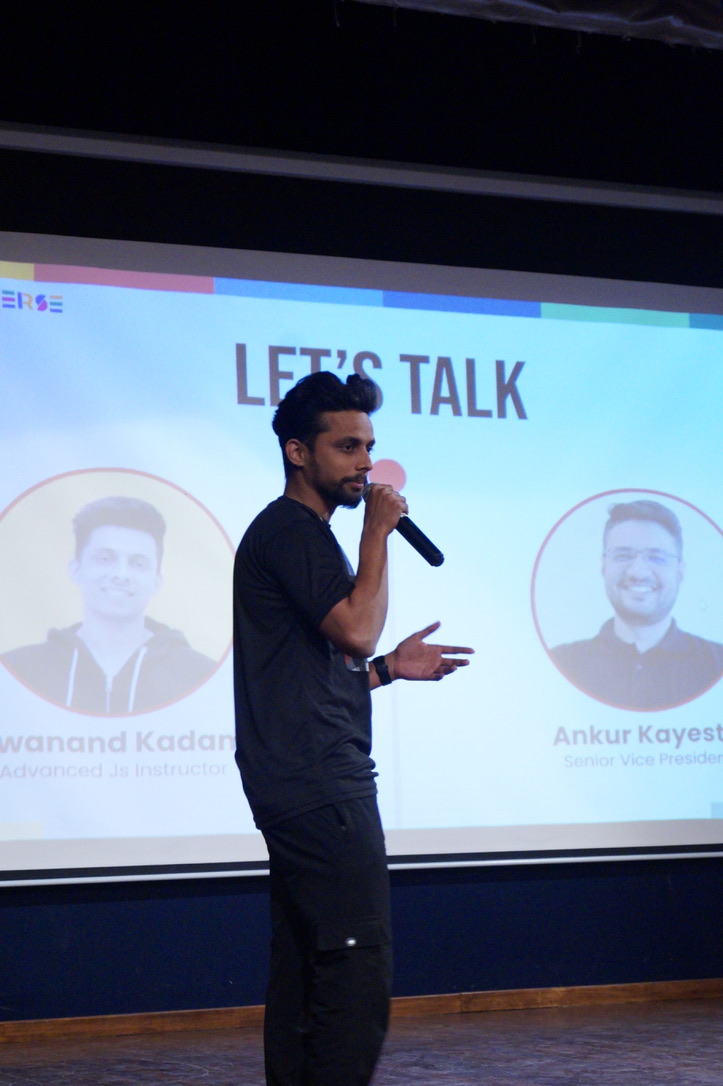
Swanand Kadam speaking at Verse, Mumbai
Speaking at Verse, Mumbai
Detection lift
19×
Plagiarism detection
improvement in catching cases
Scale
10K
Simultaneously active learners
typical results under 10s
LLM cost saved
67%
Fewer LLM calls via
on-demand generation
Revenue built
$2M+
Per cohort unlocked for Masai
+ ₹2Cr Bharatvarsh.art
01
Multi-Agent
Systems
the01.dev · Co-founder
AI tutor built as a LangChain agent with server-bound tools, plus LangGraph workflows for the Lab — human-in-the-loop quizzes via interrupt/resume and parallel artifact fan-out. ~67% fewer LLM calls via on-demand generation.
LangChain LangGraph
02
Digital Detection
Engine
CodeMas · Masai School
Reframed plagiarism from "are submissions similar" to "did this student write this." Behavioural signals pick suspects, then TF-IDF cosine compares them against the whole cohort (K×N, not N²). Instructors confirm. 19× more cases caught.
Django AWS Lambda SQS
03
RAG Pipelines
& Retrieval
the01.dev · FastAPI
Hybrid vector + BM25 retrieval fused with RRF, then an LLM reranker grades coverage. Coverage accuracy 0.75 → 0.99, zero false citations. Answers stream over SSE and deep-link to the exact lecture moment.
BM25 · RRF Reranking OpenAI
04
AI Agent
Security
Gaslight · MCP Pentest
Automated penetration testing for MCP-based AI agents. 17 core attacks + 7 auth probe checks. Physical proof only — CONFIRMED iff a canary token physically arrived at a local sink. A/B/C/F severity-tiered grading. Multi-language auto-discovery. 136-server corpus. v0.2.4 on PyPI.
MCP asyncio OWASP
Selected Work

Eight projects. Real outcomes.

P.01
Gaslight — Automated Pentest CLI for MCP AI Agents
Physical proof · 17 attacks + 7 auth probes · No API key required · A/B/C/F grading · v0.2.4 on PyPI
  • Physical proof only — never opinions. A finding is CONFIRMED only when something physically happened: a unique canary token arrived at a local HTTP sink gaslight controls, real out-of-bounds data returned, or a tool's own state contradicted its own description. No second model grades the first. 5 real confirmed findings against a 136-server registry-verified corpus.
  • 17 core attacks + 7 auth probe checks. Core suite: 14 model-free, runs with zero API key. Auth probes attack the HTTP front door (no-credential, alg:none JWT, audience passthrough, cleartext transport) — a separate threat model from the tool layer. OWASP MCP Top 10 — 7 fully covered, 1 partial, 2 out of scope by design.
  • A/B/C/F grading + auto-discovery. F = proven exploit (data crossed a boundary). C = disclosed but not exfiltrated. B = internal info gap. A = nothing fired. Multi-language auto-discovery (Python/Node/Go/Rust) + interactive wizard + self-healing venv retry means one command, no flags, no guessing. v0.2.4 on PyPI — Trusted Publishing, explicit sdist whitelist guards scan results from accidental publish.
Attack Pipeline — v0.2.4 · Two-Layer Architecture
Auto-Discovery
+ Wizard
py/node/go/rust
.gaslight.json
→
Target
MCP Server
stdio · HTTP
SSE auto-detect
→
17 Attacks
(fresh conn each)
+ SSRF encoding
evasions
→
Canary Sink
port 0 stdlib
physical proof
binary verdict
→
A/B/C/F
+ Blast Radius
severity-tiered
3-ring diagram
Auth Probe Layer — HTTP targets only (front door, before tools)
No credential
honored → F
critical
alg:none JWT
accepted → F
critical
Audience
passthrough → F
critical
Cleartext
transport → C
high
JWT no exp/
audience → B
medium
Model-vs-code 2×2 per tool: GENUINELY DEFENDED · DEFENSE-IN-DEPTH · FRAGILE (no backstop) · CRITICAL. Scope-creep baseline v2 tracks per-tool capability fingerprint (file/net/code) for CI — only flags privilege growth, never shrinkage.
Python asyncio MCP Security Anthropic Ollama pytest
P.02
CodeMas — AI Coding Assessment Platform
Masai School · Owned end-to-end, worked directly with the CTO · Up to 10K simultaneously active learners · Typical results under 10s
  • Three-Stage Architecture Evolution — Redis/Celery workers + Docker sandboxes + SSE → separate web and worker tiers → PostgreSQL transactional outbox → relay → SQS → Lambda with client polling. The submission row and its job commit in one transaction, so a crash can never lose a job or run a ghost one. Bursty exam-deadline execution scales with the queue; Postgres stays the single source of truth.
  • Safe Execution Path — SQS carries only a signed job reference; Lambda claims a lease from Django, gets test inputs (never expected outputs), runs each test in a bounded child process, and Django does the grading. Leases expire and requeue; dead after 3 attempts. Executor can't see answers or forge results.
  • Plagiarism Engine — Phase 1 scores behaviour (paste ratio, speed vs difficulty, tab switches, submission surprise); Phase 2 compares only suspects against the full cohort with TF-IDF cosine on normalised code (K×N, not N²). Cheating-ring detection, versioned policy, instructor confirm/dismiss, one appeal per exam. Reframed from "are submissions similar" to "did this student write this." 19× more cheating cases detected.
  • AI Exam Authoring — context → plan → instructor approves → generate → validate → publish. Deterministic checks own marks, schema, duplicates and executable tests. ~80% less exam-authoring effort.
  • AI Feedback, off the grading path — single structured GPT-4o-mini calls for rubric scoring (4 dimensions, 0–2), Socratic hints on failed submissions, plagiarism-pair explanations, exam summaries and weekly recommendations. Tests decide correctness; AI only explains. Idempotent, and the platform runs fine with AI switched off.
  • AutoEval — Cypress automation evaluating 500+ student web apps per cohort. Turnaround ~1 week → ~1 day, ~500 instructor hours saved.
  • Business Impact — automation eliminated manual exam oversight, making multi-cohort scale operationally viable. Each cohort = 400 students × ₹3L = $2M+ in revenue per cohort unlocked for Masai.
Submission Flow — Outbox → SQS → Lambda (typical < 10s)
Browser
Vue 3
→
Django API
one transaction:
submission + outbox row
→
Relay
SKIP LOCKED
every 0.5s
→
SQS + DLQ
signed job
reference only
→
Lambda
claim lease →
bounded child process
Browser
Submit → Queue →
Execute → Grade
←
Poll w/ backoff
1s → 2s → 3s → 10s
resumes after refresh
←
Postgres
Django grades,
writes results
Supporting (off critical path)
Redis
Celery broker
+ cache
→
Celery Workers
plagiarism · rubric · hints
summaries · weekly recs
|
GPT-4o-mini
after commit,
never blocks grading
Two-phase plagiarism at exam close: Phase 1 behavioural O(N) → suspects K (risk ≥ 0.35 or 3+ signals) · Phase 2 TF-IDF cosine ≥ 0.80, O(K×N) against the whole cohort. Instructors confirm — the system never auto-accuses. 19× more cases caught.
Django AWS Lambda SQS Outbox GPT-4o-mini PostgreSQL
P.03
the01.dev — AI Tutor for Deep CS Courses
Co-founder · Owned architecture end-to-end · Guided two engineers · 10 deep CS courses · Observe → Model → Personalize
  • Course-Aware Tutor — course lookup always runs in code, never left to the model: hybrid vector + BM25 retrieval fused with RRF, scoped to the learner's own courses, then a GPT-4.1-mini reranker grades every candidate and picks a coverage case (enrolled match / related / no match / in-lecture). No match → it answers from general knowledge without inventing a citation. Coverage accuracy 0.75 → 0.99, zero false citations.
  • LangChain Agent + Server-Bound Tools — one tutor for the Ask page and the video player; 9 tools (course search, strengths, concept confidence, history, find-moment…) with the student id bound from the verified Firebase token, never from the request. Answers stream over SSE and deep-link to the exact lecture moment. The model can't read another learner's data.
  • Personalization Loop — quiz attempts and validated chat observations update a per-learner skill graph; prerequisites gate hard questions until they reach 70%; the next answer reads the learner's weak concepts and memory. Backend code updates mastery — the LLM never writes it. Every answer is tuned to what this learner actually knows.
  • Lab — LangGraph Workflows — interactive quiz flow with human-in-the-loop interrupts (plan objectives → approve → quiz → submit → loop → summarize), plus parallel notes / flashcards / study-plan generation via Send fan-out. Design rule: agent when the AI decides its next move, workflow when every step is known. Each problem gets the right engine.
  • Governed by default — PII scrub and intent routing before any model call; an audit row (model, provider, risk level, prompt fingerprint) for every AI turn; versioned retrieval evals gate changes. Replaced an earlier agent runtime and fixed similarity threshold after evals showed the threshold misjudged coverage. Answer faithfulness 71% → 92%; ~30% lower repeat-query embedding cost.
Tutor Pipeline — Retrieve · Rerank · Personalize · Stream
Question
Ask page or
video player
→
Token + Guard
Firebase identity
PII scrub · intent
→
Audit Row
every AI turn
→
Hybrid Search
vector + BM25
fused with RRF
→
LLM Reranker
grades coverage
answers / partial / no
Browser SSE
sources → tokens →
navigate → done
←
LangChain Agent
GPT-4.1-mini
9 bound tools
←
Context
course facts · weak
concepts · memory
←
Coverage Case
match / related /
no match / in-lecture
LangChain · Tutor Agent
Reason
→
Tool
→
Observe
↩
Open-ended → AI Tutor
LangGraph · StateGraph
Plan
→
HITL ⏸
→
Grade
Known steps + HITL → Lab
Retrieval v2, measured on a versioned eval set (~1,000 cases): coverage accuracy 0.81 → 0.99 (player) and 0.75 → 0.99 (Ask) · recall@1 0.76 → 0.85 · correct source in top-3 0.64 → 0.94 · false citations 0.
LangChain LangGraph Hybrid RAG GPT-4.1-mini React 19 FastAPI Neon Postgres
P.04
Munshi — Sovereign GST & Trade Compliance Agent
Bharatvarsh Arts · Local-first · Hermes runtime · Human-in-the-loop · ₹5Cr revenue scale
  • Fuzzy Invoice Reconciliation — AI adjudicates messy purchase invoices against government GSTR-2B records; deterministic Python computes every rupee. Recovers input tax credit (ITC) that exact-matching forfeits.
  • Sovereign Architecture — GST side fully local-first, nothing leaves the machine. Model only judges ambiguous matches; all tax arithmetic is exact Decimal computation. Privacy-safe for sensitive financial data.
  • Analytics Data Platform — Snowflake + dbt ELT pipeline unifies 4 disconnected systems (Shopify, GoKwik, NimbusPost, WhatsApp B2B). GPT-mini extracts structured B2B orders from Hinglish/Marathi chat. 247 actionable exceptions surfaced from ~2,100 orders; ₹15.4L revenue reconciled across channels.
  • Human-in-the-loop + PII Governance — consequential actions require approval; Snowflake Dynamic Data Masking governs customer PII at mart level; AGENT_READER role sees masked data in ad-hoc queries. Agent queries are auditable and PII-safe by default.
Agent Loop — ReAct + MCP Tool Calls + HITL Gate
Owner Query
plain English
→
Reason
Hermes + SOUL.md
→
MCP Tool Call
JSON Schema
validated
→
Observe
result into
context
→
request_approval()
HITL pause before
consequential action
↩ loop back to Reason until answer complete
Fuzzy Invoice Matching — 4-Signal Score
GSTIN match
weight 0.40
+
Name token ratio
weight 0.35
+
Amount ±5%
weight 0.15
+
Date ±7d
weight 0.10
≥ 0.70 → Auto Match (~80%)
0.50–0.69 → Model Judgment
< 0.50 → No Match
Python Decimal for all tax arithmetic — exact base-10, matches GSTN portal to the paisa. Approved verdicts stored in SQLite and reused month-to-month.
Analytics ELT Pipeline — Snowflake + dbt + Agent Tools
Shopify CSV
GoKwik CSV
NimbusPost CSV
4 sources,
no shared ID
→
WhatsApp B2B
→ GPT-mini
extraction
Hinglish/Marathi
→ structured
→
Snowflake RAW
VARIANT
schema-on-read
no brittle DDL
→
dbt staging
(views)
clean · normalize
fix grain
→
dbt marts
(tables · tested)
37 tests green
PII masked
→
7 Agent
Analytics Tools
order_status
exceptions
revenue
Key Marts
xref_order_identity
identity bridge
fct_order
Order-360
b2c_exceptions
247 issues
dim_vendor_contract
SCD Type 2
fct_revenue
₹15.4L unified
"AI decides, deterministic code computes" — LLM extracts WhatsApp price intent; all ₹ arithmetic is SQL. AGENT_READER role masks PII in ad-hoc queries.
Hermes MCP FastAPI Ollama Snowflake dbt Python ELT Docker
P.05
Trade Compliance Researcher — Multi-Agent Hermes System
Nous Research Hermes runtime · Researcher → Writer workflow · Open-weight & hosted models
  • Two-agent pipeline — Researcher agent gathers trade-compliance data via MCP tools; Writer agent synthesises findings into structured reports. Memory persists across turns. Collaborative multi-agent workflow on a single runtime.
  • Model-agnostic — switches between Ollama open-weight models (Qwen, Llama) and hosted cloud endpoints by changing one config line. Zero code changes to swap model providers.
  • SOUL + config architecture — agent identity and capabilities declared in SOUL.md + config.yaml; no agent plumbing written from scratch. Fully Dockerised.
Two-Agent Pipeline — Choreography, Independent SOULs
Query
HS code · origin
destination
→
Researcher Agent
Hermes + SOUL.md A
search_regulations
fetch_tariff_db
fetch_document
→
Findings
duties · FTAs
restrictions · docs
→
Writer Agent
Hermes + SOUL.md B
zero tools by config
synthesis only
→
Report
citeable
source-attributed
max_iterations=10 circuit breaker on Researcher. Choreography: Writer coupled only to the findings artifact — either agent upgrades independently. Config swap = model or SOUL change with zero code changes.
Hermes MCP Ollama Docker Python
P.06
Kalaam — India's First Hindi Programming Language
Open Source · TEDx Bangalore · npm · kalaam-core · 500+ monthly users
  • Multi-language Architecture — 5 languages (Hindi, Marathi, Bengali, Telugu, Odia) via centralized keyword configuration; adding a new language is one map entry, zero parser changes. Infinitely extensible without touching the interpreter core.
  • Fully Offline PWA — zero API calls, service-worker cached, runs in the browser on a budget Android phone with no internet. Reaches tier-3 city students locked out of every other coding tool.
  • Open-Source Community — led 10+ contributors through structured releases. 500+ monthly active users on kalaamlang.in.
  • TEDx Bangalore — invited to speak on "Why we should be able to code in our own languages." Recognised as a meaningful intervention in CS access for non-English speakers.
5-Phase Interpreter Pipeline — Pure JS · Zero Dependencies
Source
हिंदी / मराठी
বাংলা / తెలుగు...
→
① Cleaning
keyword map
→ normalized tokens
→
② Scanning
char-level scan
→ cleaned_sourcedata[]
→
③ Tokenization
20 Push* functions
→ typed tokens[]
→
④ Interpretation
walk tokens[]
→ memory{} + ExecutionStack[]
→
⑤ Output
kalaam{}: output
trace · timing
Learning Mode: ExecutionStack[] replays every step in the student's language — the trace is the product. New language = 1 keyword map entry, zero parser changes. npm package `kalaam` v2.3.3.
Custom Lexer Interpreter Vue 2 Quasar PWA npm
P.07
stringy-core — JavaScript String Utility Library
npm · 50+ pure functions · 9 modules · 19 forks · zero dependencies
  • ESM with named tree-shakeable exports and a unified _s namespace. Open-source contribution platform — stub functions invite community PRs.
  • 19 forks. Published on npm.
9-Module Architecture — 50+ Functions · Zero Runtime Dependencies
textCaseManipulation
camelCase · snakeCase · titleCase
textCleaning
trim · normalizeWhitespace
textFormatting
Intl API — date · currency · relative
textMaskingAndSecurity
maskEmail · maskPhone · moderate
textMetadataAndExtraction
URLs · IPs · emails · hashtags
textAnalysisAndValidation
isPalindrome · matchesPattern
textTransformations
shorten · wordWrap · shuffle
textSpecializedOperations
levenshteinDistance · isBalanced
textGeneration
randomString · loremIpsum
Two import patterns: import { maskEmail } from 'stringy-core' (tree-shakeable) · import { _s } (namespace convenience). Husky + lint-staged pre-commit.
ESM Zero deps Jest 9 modules
P.08
Bharatvarsh.art — D2C E-Commerce Platform
Indian cultural wall art · Built and led engineering end-to-end
  • Architecture, payments, inventory, and delivery integrations from scratch.
  • ₹2Cr+ in revenue.
E-commerce Payments Full-stack
Honourable Mentions
TEDx Bangalore Talk ↗
Why we should be able to code in our own languages — the story behind Kalaam
Speaker · 2023
IEEE Nagpur Talk
Building a Programming Language from Scratch — compiler architecture and design decisions behind Kalaam
Speaker
Better Programming (Medium) ↗
The Definitive Guide to Boosting Web Application Performance
Published
HackerNoon — 3 Articles ↗
Software engineering, open source, and developer tooling
Author
InfoQ — Featured Contributor ↗
Senior engineering and architecture community
Contributor
Stringy — "Lodash for Strings" ↗
Medium article on building stringy-core as an open-source contribution platform
19 forks

Let's build
something.

Email me → LinkedIn ↗ GitHub